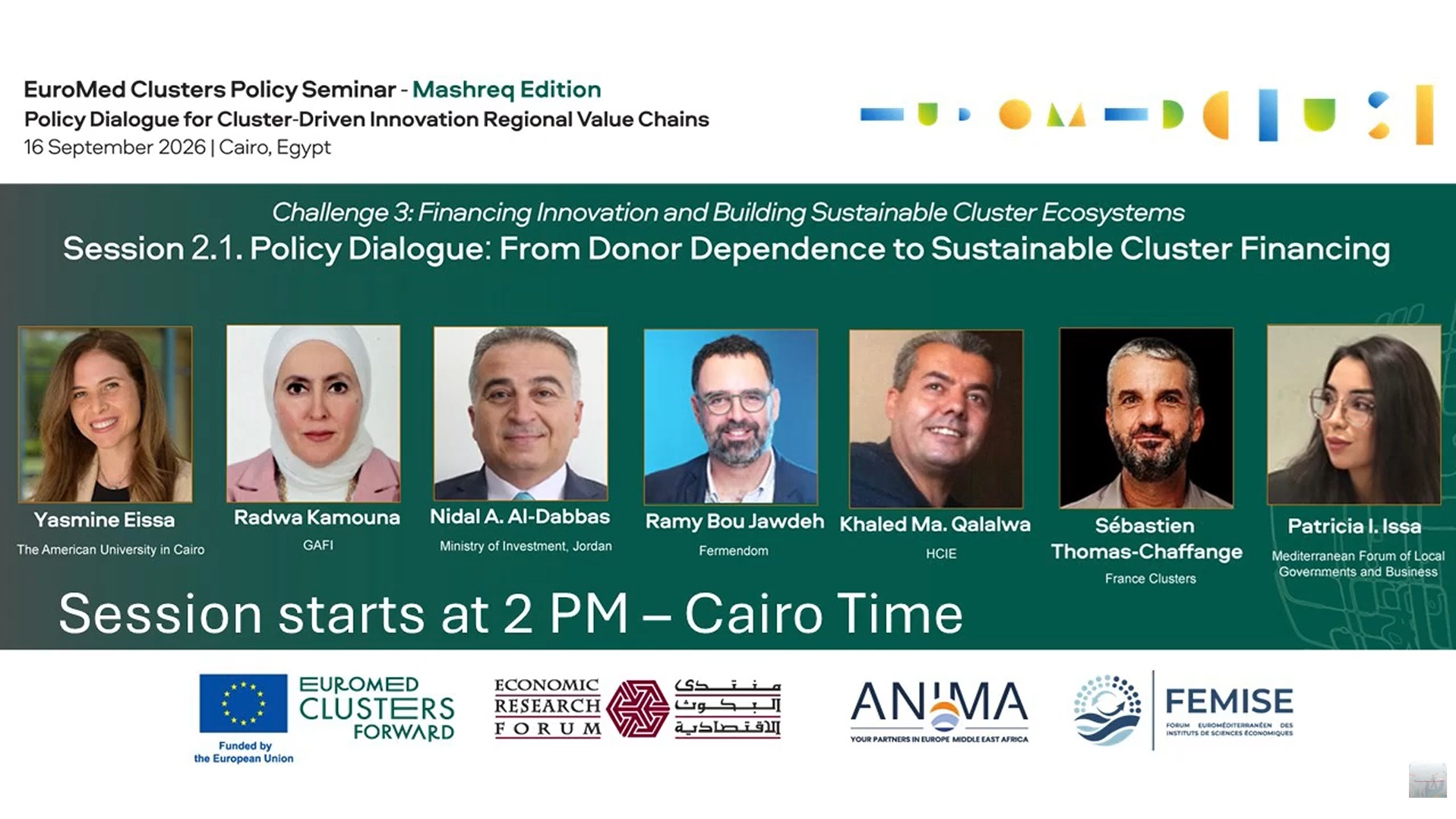

On 16 September 2026, the Economic Research Forum (ERF) hosted the EuroMed Clusters Policy Seminar – Mashreq Edition in Cairo, Egypt, bringing together policymakers, cluster representatives, private-sector leaders, researchers and international experts to explore how cluster ecosystems can drive innovation, industrial competitiveness and regional economic integration.
Held within the framework of the European Union-funded EuroMed Clusters Forward initiative, in collaboration with FEMISE and ANIMA Investment Network, the seminar addressed shared challenges across Egypt, Jordan, Lebanon and Palestine. Discussions focused on three priorities: stronger cluster governance and institutional coordination, more effective innovation ecosystems and research–industry collaboration, and sustainable financing for long-term growth.
Representing the Mediterranean Forum of Local Governments and Business, Dott. Patricia Issa, Vice President of the Forum, participated in Panel 3, “From Donor Dependence to Sustainable Cluster Financing.” Her contribution emphasized the need to move beyond short-term, project-based funding and towards financing models that support private investment, industrial partnerships and integration into regional and global value chains.
For Dott. Patricia Issa, the central question is not simply how to secure more funding for clusters, but how to ensure that financing translates into lasting economic activity.
Capital is not sustainable if it finances isolated projects. It becomes sustainable when it supports productive ecosystems, cross-border partnerships, industrial cooperation and access to markets.
Development funding remains important, particularly when businesses face barriers related to technology, international standards, market entry and institutional capacity. However, its role should be catalytic: reducing initial risks, addressing structural obstacles and creating the conditions for private-sector participation.
The longer-term objective is to establish a progression from enabling finance to strategic partnerships, joint ventures, co-production and investment for commercial expansion. Financing should not end when an individual project closes; it should help build productive capabilities and business relationships that continue to generate value.
Lebanon illustrates both the challenges and the potential of this approach. Despite a difficult economic environment, privately led industrial initiatives continue to demonstrate resilience. The opportunity lies in connecting that capacity more systematically with international partners, technology and markets.
This requires financing mechanisms that support not only individual enterprises, but also technology transfer, industrial upgrading, joint production, supplier integration and compliance with international market requirements.
Partnerships with European and Mediterranean companies can provide a practical route forward. Through joint ventures and co-production, businesses can combine complementary capabilities, share investment and risk, and reach markets that may be difficult to access independently.
For Lebanon and the wider Mashreq, sectors linked to production, food, water, energy and logistics can play an important role in strengthening economic resilience and creating opportunities for cross-border industrial collaboration.
The wider Mediterranean dimension is equally important. Egypt, Jordan, Lebanon, Palestine and European partners possess complementary industrial capabilities, technical expertise, production capacities and market access. Connecting these strengths can create economies of scale, improve logistics and generate new investment opportunities.
Clusters can serve as platforms for this cooperation, bringing companies, research institutions, investors and public authorities into a more coordinated framework. The decisive step, however, is translating this potential into concrete commercial relationships and viable projects.
This is where institutional cooperation and business engagement must work together. Public institutions and development partners can help establish enabling frameworks, while private-sector partnerships translate those frameworks into productive activity.
The approach advanced by the Mediterranean Forum of Local Governments and Business is grounded in the conviction that institutional dialogue must lead to economic cooperation. By connecting public and private stakeholders across borders, the Forum seeks to facilitate collaboration and support industrial initiatives with a clear commercial rationale.
Reducing dependence on donor funding does not mean eliminating development finance. It means using it strategically to unlock opportunities, address initial barriers and enable partnerships that can increasingly attract private capital.
The ultimate measure of success is not simply the number of projects financed, but whether those projects generate durable business relationships, strengthen industrial capacity and integrate companies into functioning regional and global value chains.
As highlighted by Dott. Patricia Issa during the seminar, the challenge from Lebanon to the wider Mediterranean is to build financing mechanisms that do more than sustain clusters as organizations. They must help clusters become connectors of investment, industrial cooperation and long-term economic opportunity.
Dott. Patricia Issa’s participation in the seminar reflects the Mediterranean Forum of Local Governments and Business’s ongoing commitment to strengthening dialogue between institutions, businesses and industrial ecosystems across the Mediterranean.
The Forum extends its appreciation to the Economic Research Forum (ERF) and the partners involved in the EuroMed Clusters Policy Seminar – Mashreq Edition for facilitating this important exchange.
To learn more about the seminar and its discussions, visit the official event page.
The Mediterranean Forum of Local Governments and Business welcomes dialogue with institutions, companies, cluster organizations and potential partners interested in sustainable investment, industrial cooperation, cross-border partnerships and Mediterranean value-chain development. By bringing the right stakeholders together, the Forum seeks to turn shared priorities into concrete opportunities for collaboration.
For those working on these challenges, the conversation does not end with the event. It is where the next partnerships begin.
Mediterranean Forum of Local Governments and Business
Contact: segreteria@mediterraneanforum.com