
A Strategic Blueprint for Mediterranean Policy and Enterprise Leaders
By Patricia Issa, Vice President of the Mediterranean Forum of Local Governments and Business.
The Strait of Hormuz crisis of 2026 has fundamentally reordered the global economic landscape. As the final trimester of the year approaches, the geopolitical shockwaves that began with maritime disruptions are no longer isolated to Persian Gulf oil terminals. Instead, they have migrated directly into European industrial supply chains, Mediterranean industry operations, and municipal utility budgets.
While diplomatic backchannels continue to pursue structural de-escalation, the tactical reality remains clear: as of late August 2026, the maritime bottleneck remains active, commercial shipping lines continue to operate under heightened naval security protocols, and strategic energy reserves have been severely drawn down. For leadership across the Mediterranean basin, where trade routes, energy imports, and infrastructure intersect, crisis management must now transition into predictive policy execution.
The immediate policy priority for governments across Europe and Asia heading into Q4 2026 is the replenishment of depleted energy stockpiles. The initial closure of the Strait disrupted roughly 25% of global seaborne crude and 20% of global liquefied natural gas (LNG) trade, marking the single largest physical supply disruption in modern petroleum history according to International Energy Agency (IEA) benchmarks.
To cushion global markets against catastrophic price spikes during the initial supply contraction, member states conducted emergency releases from coordinated Strategic Petroleum Reserves (SPRs). However, with the European winter heating season approaching, reserve cushions are at historic lows. Policy makers are currently shifting from emergency drawdowns to aggressive mandatory inventory rebuilding protocols ahead of strict November deadlines.
-Regional and local leaders must brace for structural energy cost floors. Public procurement offices and enterprise CFOs should prioritize forward-hedging energy contracts, accelerating local renewable integration, and establishing mandatory regional gas storage buffers to prevent winter industrial curtailments.
The commercial shipping ecosystem has undergone structural rerouting. Following severe hull insurance surcharges and direct risk to commercial vessels, maritime transit times between Asia, the Gulf, and the Mediterranean inflated dramatically as carriers diverted around the Cape of Good Hope or waited for naval escort convoys under Operation Project Freedom.
In response, international transportation and defense ministries are formalizing permanent maritime security architectures while aggressively expanding overland bypass corridors. Key infrastructure assets, such as Saudi Arabia’s East-West Petroline (connecting Persian Gulf fields to the Red Sea port of Yanbu), Abu Dhabi’s ADCOP pipeline terminating in Fujairah, and rail/port expansions at Oman’s Duqm and Salalah, are seeing record throughput and emergency capacity expansions.
-Mediterranean port authorities must reconfigure berth schedules and intermodal freight connections to handle altered shipping patterns. Industry leaders must audit supply chain single-point dependencies and align with Mediterranean transit hubs capable of accommodating expanded feeder network routes.
Central banks, including the Federal Reserve and the European Central Bank (ECB), face a delicate balance for the remainder of 2026. The commodity price shock of early 2026 created a secondary inflationary wave that hit global manufacturing, agricultural fertilizer costs, and maritime freight tariffs.
While spot oil prices have moderated from their crisis peak due to coordinated reserve actions and bypass expansion, residual inflation remains embedded in corporate supply chains. Central banks have been forced to delay anticipated interest rate cuts, keeping borrowing costs elevated to contain inflation even as real economic growth across manufacturing hubs decelerates.
-Local government economic development agencies must step in with targeted working-capital support and tax-deferral programs for small-to-medium enterprises (SMEs) hardest hit by high input costs and elevated interest rates. Corporate decision-makers must optimize cash reserves and maintain conservative capital expenditure strategies into early 2027.
Perhaps the most critical takeaway from the 2026 crisis is the deep interdependence of energy chokepoints and municipal utility survival. Regional conflict expansion in the Persian Gulf underscored the extreme vulnerability of coastal infrastructure, most notably seawater desalination plants, power generation stations, and industrial water intake systems.
In arid and Mediterranean coastal regions, desalination provides up to 80% of municipal potable water. Attacks or operational disruptions to these facilities pose immediate humanitarian and economic catastrophes. Defense planners and utility boards across Europe, North Africa, and the Middle East are reclassifying water treatment facilities and energy telemetry systems as primary national defense assets.
-Municipal authorities must immediately audit the physical and cyber security posture of local water treatment, power distribution, and port telemetry networks. Co-investment frameworks between public utilities and private security providers will be a top capital priority for Q4 budget allocations.
The fallout from the Strait of Hormuz crisis has made one reality abundantly clear: regional stability can no longer be decoupled from global macro risks. As Mediterranean economies prepare for la ripartenza after the August slowdown, success will depend on proactive alignment between local government leadership, regional port administrations, energy producers, and private enterprise.
Sitting at the crossroads of European, African, and Asian trade corridors, the Mediterranean basin is uniquely exposed to these shifting global dynamics. Isolated policy responses are no longer sufficient. Mitigating supply chain bottlenecks, securing energy reserves, protecting vital coastal assets, and maintaining industrial competitiveness demand collaborative, cross-border strategies.
On regional markets’ adaptation through cooperation and building long-term resilience, the Mediterranean Forum of Local Governments and Business is conducting key strategic discussions bringing together expertise in:
Navigating this complex economic environment requires active alignment between public sector leadership and private enterprise.
Policy makers, industry leaders, corporate executives and economic strategists are invited to keep an eye on the Mediterranean Forum calendar and join the upcoming discussions, roundtables, and working groups.
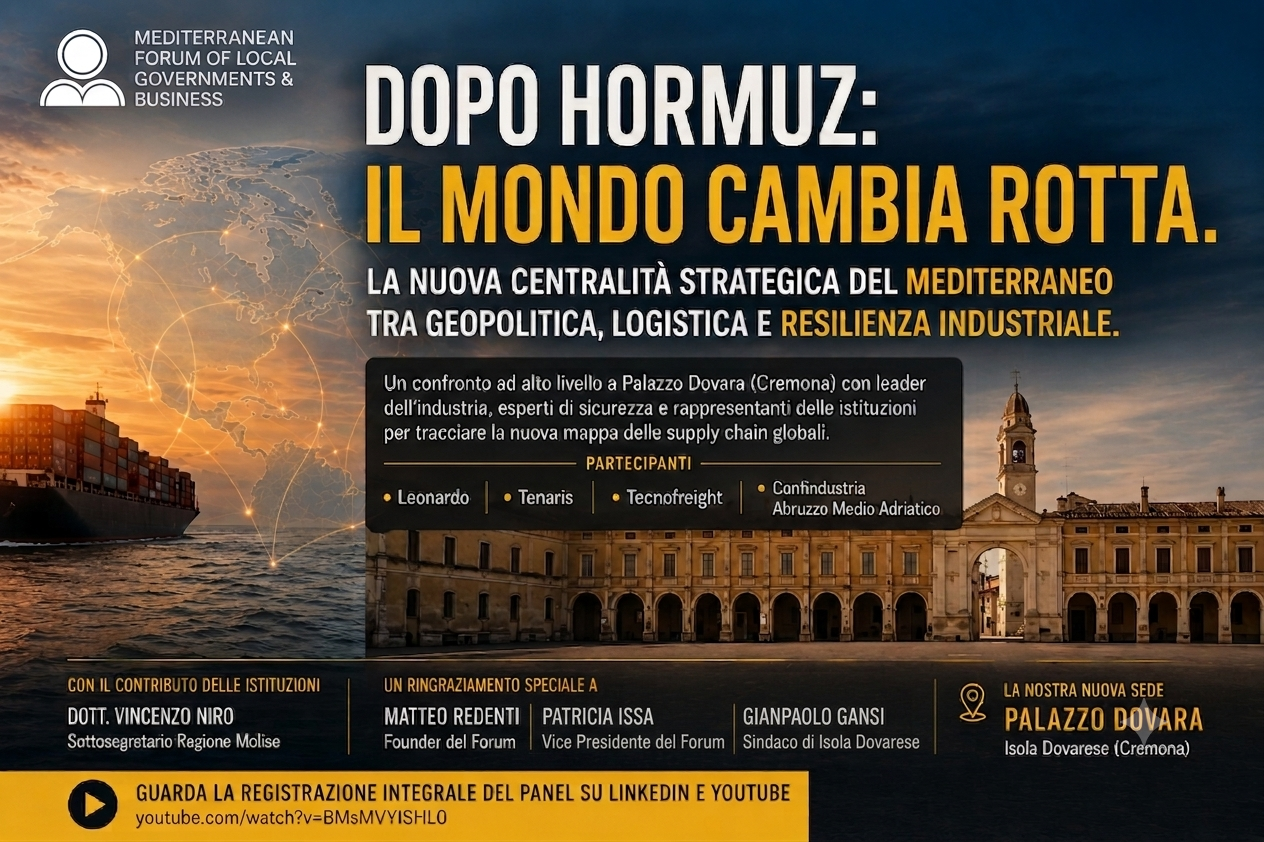
Within the context of this theme, kindly check the latest Mediterranean Forum of Local Governments and Business panel addressing the situation after the Hormuz Crisis; featuring Leonardo S.p.A, Tenaris, Tecnofreight and Confindustria Abruzzo Medio Adriatico, through the following link:
For more information about our upcoming calendar of events, kindly get in touch through segreteria@mediterraneanforum.com
Patricia Issa – Vice President
Mediterranean Forum of Local Governments and Business